
Ampol Group Logo
Product CoE
Mandate & Charter · v2

Product Centre of Excellence

A centralised function that guides through expertise, builds capability in domain teams, and creates the cross-domain visibility that no single team can achieve alone.

Owner
Products@Ampol
Facilitated by
Oppostite Logo
Review cycle
6 months
Hero artwork
01 · The Model

How the CoE sits in the business.

The CoE is an advisory and strategic change agent, providing an enterprise view, connecting decisions to evidence, and coaching the business on language, process, and discipline. It indirectly strengthens Ampol Group's four customer domains.

Customer Experience Domains — strengthened & matured
Smart Mobility
Digital & payment
Everyday / Consumer
Fuel · EV · food & amenities
Operational Mobility
Fuel · lubricants · energy
Commercial Mobility
Fleet & integrated mobility
Business Operations — day-to-day delivery & ownership
Business Operations
Domain teams own products, run delivery, make commercial decisions
Frameworks · Coaching · Visibility · Facilitation
Requests · Evidence · Escalations
Product Centre of Excellence — advisory by default
Product Centre of Excellence
Enterprise View
  • Group-level product performance data, insights & reporting
  • Cross-domain dependencies & shared benefits
  • Portfolio-level prioritisation & evidence-based recommendations
Connector to Evidence
  • Product lifecycle assessment & maturity evaluation
  • Product positioning & market fit methodology
  • Dashboard metrics, reporting & artefact design
Frameworks & Language
  • Lifecycle language, stage definitions & classification criteria
  • Product Playbook & stage transition design
  • RACI frameworks for product roles & accountabilities
Coaching & Capability
  • Product capability uplift, coaching & co-design
  • Product Library design & maintenance
  • Facilitating group-level prioritisation across the portfolio
Authority is advisory by default. The CoE escalates only when systemic risk, ownership gaps, or persistent non-compliance emerge — and discipline is expected to increase progressively as trust is established.
Customer Perspectives — the people behind the portfolio
Frontline worker using a tablet
On Site

Operational products need to work in live, complex environments where teams make decisions quickly.

Field worker pointing toward a task or destination
In The Field

Mobility offers need to be clear and dependable for teams managing routes, assets and work on the move.

Everyday customer holding a takeaway coffee and keys
Everyday

Retail experiences across fuel, EV, food and convenience should feel simple, useful and easy to repeat.

Digital customer looking at a mobile phone
Digital

Payment and app experiences should connect the portfolio with a seamless digital layer for customers.

02 · Why this exists

Three problems the CoE is built to solve.

The CoE formed to help solve three key business problems and facilitate increased product performance across Ampol Group.

Problem 01
Product work is fragmented across domains.
The CoE brings an enterprise-wide view — surfacing risks, dependencies, and shared benefits that no single domain can see alone.
Problem 02
Decisions are made without consistent customer evidence.
The CoE connects leaders to evidence — making sure customer signal and commercial viability shape product decisions together.
Problem 03
Ownership and lifecycle discipline vary widely.
The CoE builds shared language and capability — common lifecycle stages, processes, named owners, and the dedicated time, advice and support to apply them well.
03 · Product Framework

The shared language that has been created.

Ampol Group has established definitions for product as well as supporting enablers and magnifiers. Four customer domains are also described below.
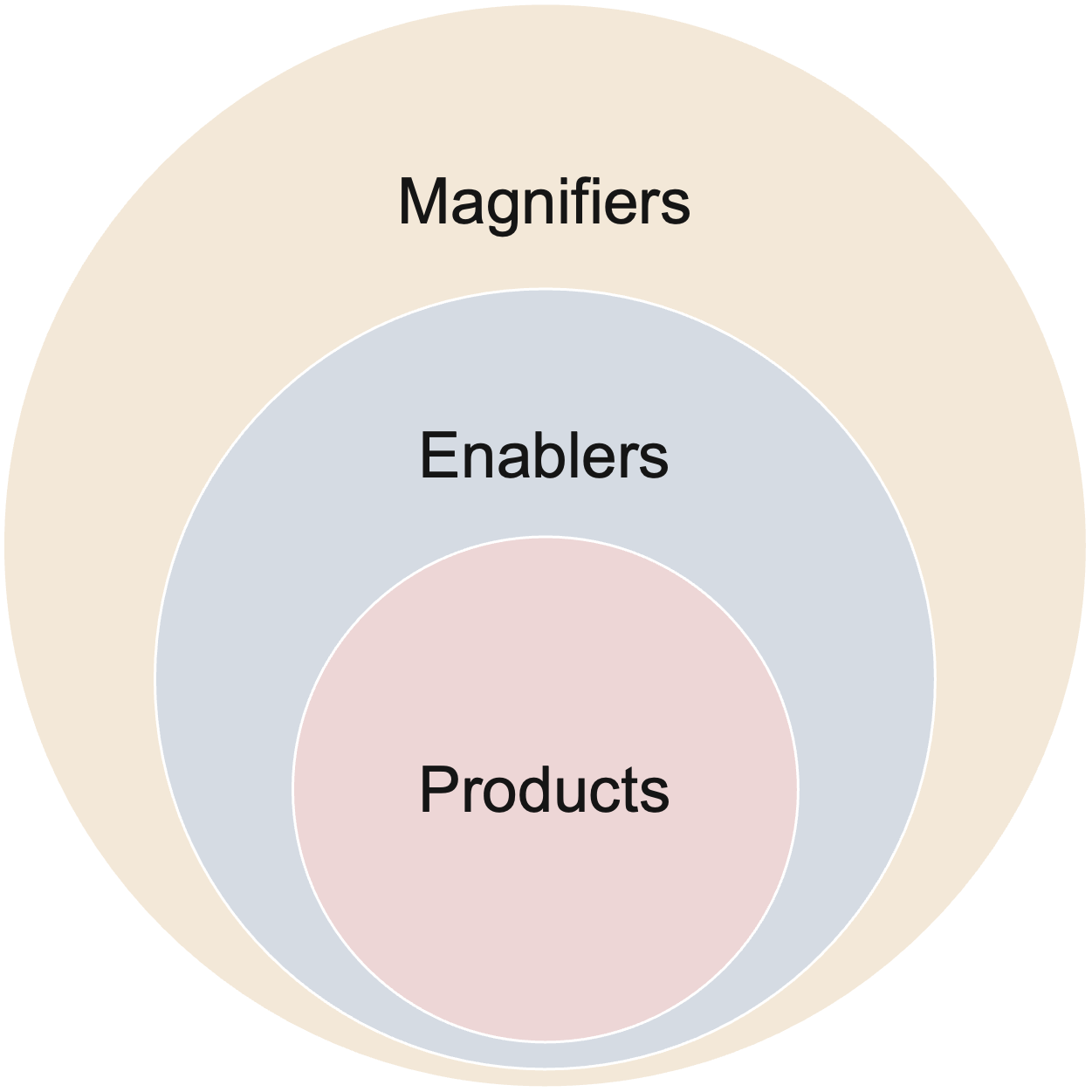
Diagram showing Products nested inside Enablers nested inside Magnifiers
The charter uses a nested model: Products sit at the core, supported by Enablers and amplified by Magnifiers.
Product

Offerings that are directly bought, subscribed to, or consumed by customers and generate value and revenue.

Enabler

Systems, capabilities, and infrastructure that allow products to function and scale.

Magnifier

Features that amplify reach, differentiation, and competitiveness of the core product offer.

Smart Mobility

Secure digital and payment experiences that unify mobility and energy offerings.

Everyday / Consumer Mobility

Convenient and predictable experiences across fuel, EV charging, food and amenities.

Operational Mobility

Reliable fuel, lubricant and energy solutions that prioritise safety, continuity and uptime.

Commercial Mobility

Integrated mobility solutions that optimise cost and simplify fleet operations.

In this charter, domain refers to one of the four experience domains. Portfolio refers to the collective set of products across all domains, viewed at group level.
04 · Authority

Advisory by default.

The CoE is an advisory group but will be involved in highlighting where there are risks and opportunities that need attention.

Default Mode

Advisory.

The CoE shares frameworks, provides coaching, documents observations, and reports insights. Domain teams decide whether and how to act.

Support is always accompanied by a specific action plan — what will be done, by whom, by when.

Default trigger A domain asks for help, or the CoE identifies an opportunity worth raising.
Elevating Risks & Opportunities

Evidence-based escalation.

When the CoE identifies systemic risk, ownership gaps, or persistent non-compliance, it raises these risks with evidence to the appropriate leadership forum.

The CoE will seek to ensure there is clear ownership clarity and portfolio-level risk have the right accountabilities.

Triggers Systemic risk · ownership gap · cross-domain conflict that cannot be resolved at domain level.
Discipline is expected to increase progressively over time as trust, evidence, and shared language are established.
Illustration of a frontline worker using a mobile device at an Ampol site
05 · Known For

The story we want to tell.

When the CoE is live and working well, this is what the business will see, hear, and experience.

Building Capability
The CoE uplifts domain teams with the skills and frameworks to manage their products well. Offers of support come with action plans and tools.
Success means the CoE becomes less needed over time, not more. Teams are self-sufficient and confident in their product practices.
Creating Visibility
The business has a clear, enterprise-wide view of its product portfolio. Performance, dependencies, and opportunities are visible.
Leaders make decisions with confidence because they can see across domains, not just within them.
Creating Fitness for Purpose
Specific product challenges are catalysts for systemic improvement and assessing whether current models and ways of working are still right.
When something isn't working, the CoE helps the team redesign the approach.
Keeping Customer at the Centre
Customer evidence and commercial viability drive product decisions with the business.
Product decisions feel grounded. Teams can point to the evidence behind their choices.
Building Lifecycle Discipline
The business has a shared rhythm for how products move through a lifecycle. The CoE acts as a facilitator of consistency and portfolio health.
There's a common language, a shared playbook, and a clear sense of who owns what at each stage.
06 · Responsibilities

What the CoE does and what is outside of scope.

Ownership of products remains with business units. The CoE works with the business to support product reviews and lifecycle management. It does not take over accountability for product performance.

Our Responsibilities

1 Lifecycle & Frameworks

  • Designing and promoting the lifecycle language, stage definitions & classification criteria
  • Co-designing and managing the 'Product Playbook' ownership & stage transition design
  • Creating and maintaining RACI frameworks for product-related roles & accountabilities

2 Visibility & Reporting

  • Facilitating group-level product performance data, insights & reporting
  • Product Library design & maintenance
  • Identifying cross-domain dependencies & shared benefits

3 Capability & Coaching

  • Facilitating continuous improvement and uplift of product capability
  • Co-designed frameworks & processes with teams who are involved in customer domains
  • Using specific problems as catalysts for systemic improvement

4 Portfolio & Prioritisation

  • Facilitating group-level prioritisation across the portfolio
  • Conducting product lifecycle assessment & maturity evaluation
  • Develop and communicate evidence-based recommendations for stage transitions

5 Customer & Market Fit

  • Support product positioning & market fit methodology (the process, not the execution)
  • Facilitate the use of customer evidence & commercial viability assessments to drive product decisions together
  • Help gather and support gathering of supporting evidence-based decisions & portfolio health
Out of Scope

1 Day-to-Day Delivery

  • Operational product management remains with domain teams
  • The CoE facilitates and recommends. It does not decide for domains

2 Commercial Decisions

  • Domain-specific commercial decisions stay with domain teams
  • Business unit prioritisation

3 Technology & Platforms

  • Technology platform choices sit with Technology, Digital and Data
  • System architecture and tooling selection not a CoE function

4 Research & Design Execution

  • Customer research execution. The CoE provides support and advice on how to gather and use evidence but does not conduct the research
  • Product design and CX design execution is a domain capability

5 Product Decisions

  • Making product decisions outside the business unit
  • Blocking or stopping innovation
07 · Scope & Decision Rights

What the CoE decides, recommends, and where it does not get involved.

Ownership of products remains with business units. The CoE works with the business and does not take over accountability for product performance. Filter the matrix to see where authority sits.

Area Authority In practice
Dashboard metrics & reporting Decide Defines what gets measured and how it is reported at portfolio level.
Template & artefact design Decide Owns design and maintenance of lifecycle artefacts, stage transition templates, and assessment tools.
Lifecycle gate criteria Decide Defines what each lifecycle stage transition requires. Domain teams apply the criteria to their products.
Product classification Decide Determines what counts as a Product, Enabler, or Magnifier.
Cross-domain coordination Decide Convenes domain teams when dependencies or overlaps are identified.
Portfolio prioritisation Recommend Provides evidence-based recommendations at group level. Decisions sit with domain leadership and executive forums.
Lifecycle stage transitions Recommend Proposes stage changes (including launch and retirement) based on evidence. Domains decide.
Owner assignment Recommend Identifies ownership gaps and recommends named owners. Domain leadership decides.
Capability assessment Recommend Evaluates product maturity and recommends capability interventions.
Day-to-day product delivery Out of scope Operational product management remains with domain teams.
Domain commercial decisions Out of scope The CoE provides evidence; domains make commercial decisions.
Technology platform choices Out of scope Technology decisions sit with Technology, Digital and Data.
Customer research execution Out of scope The CoE ensures evidence is used — it does not conduct the research.
Product & CX design execution Out of scope Design execution is a domain capability and not a CoE function.
Decision rights will be reviewed after the first six months of operation.
08 · Success Markers

The Success Markers for the CoE.

The following summarises what would be seen if the CoE is successful.

Posture

Ownership is clear.

Ambiguity about who owns products and Enablers in target domains has measurably reduced. Named lifecycle owners exist where they did not before.

Practice

Shared language is in everyday use.

Lifecycle terminology and the Product / Enabler / Magnifier model are used consistently in governance forums, reviews, and everyday conversations.

Practice

Teams seek the CoE out.

Domain teams proactively request CoE help, facilitation, and input into product decisions rather than the CoE having to insert itself.

Proof

Risks surface and get acted on.

Cross-domain risks and dependencies are identified through CoE activity, business stakeholders are acting on them, and the CoE is consulted early in product-related decisions. Evidence-based, prioritised roadmaps exist for target products.

Proof

CoE tools and artefacts are in use.

CoE tools and artefacts have been designed, developed, launched and are in use across the business.

Practice

Accountabilities are reconciled.

Ownership in forums and decision-making is clearer with artefacts being used to reconcile accountabilities (e.g. use of RACI).

Practice

Product Playbook is guiding decisions.

The Product Playbook is being used to guide development and management decisions across the business.

Long-term

Customer domain performance has increased.

There is overall increased evidence of customer domain performance, which means the understanding of our customers has increased and ultimately increased our Ampol Group product performance.

09 · Endorsement

Signatories.

This charter is endorsed by the following signatories, confirming the mandate, scope, and authority of the Product Centre of Excellence.

Executive Sponsor
[ Name ]
Signature 
Date 
CoE Lead
[ Name ]
Signature 
Date 

You've started providing feedback — thanks!